Know your edge before you sit down.
A hand-by-hand Monte Carlo simulator for the bet spread you actually plan to play. Set your count, deviations, table rules, and bet ramp, then read the edge, the variance, and the risk of ruin. These are the figures you size a bankroll on.
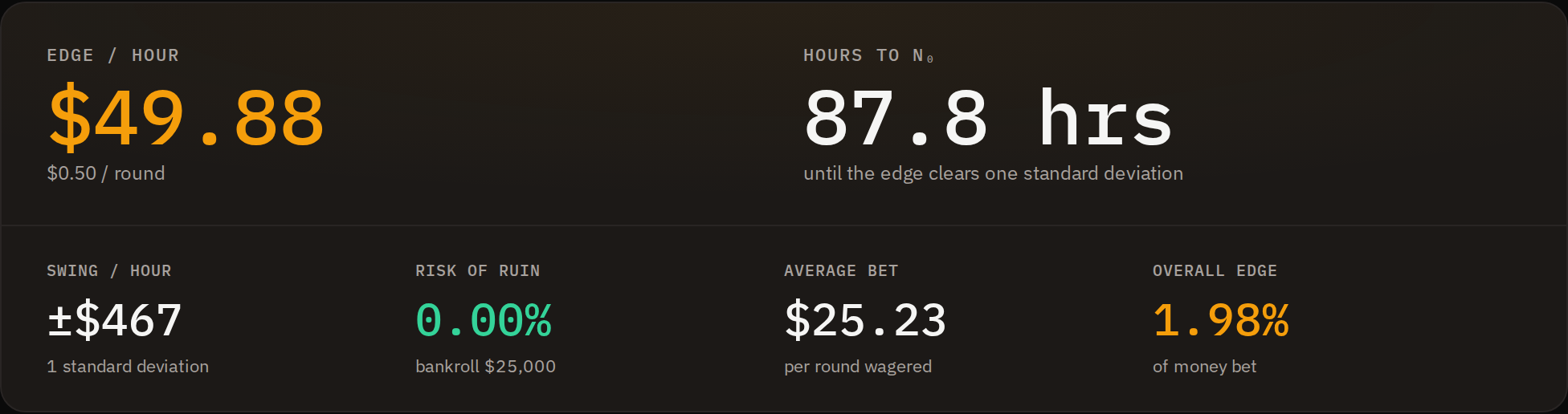
It plays the cards.
The simulator shuffles real shoes and plays every hand to the end: hitting, doubling, splitting, taking insurance, and playing one or two hands at a time against the dealer. Every seat is dealt from one shared shoe, so effects that a closed-form formula has to approximate instead fall out of the play itself. That includes how two hands move together, the extra variance that doubles and splits add, and the way your edge shifts with the count.
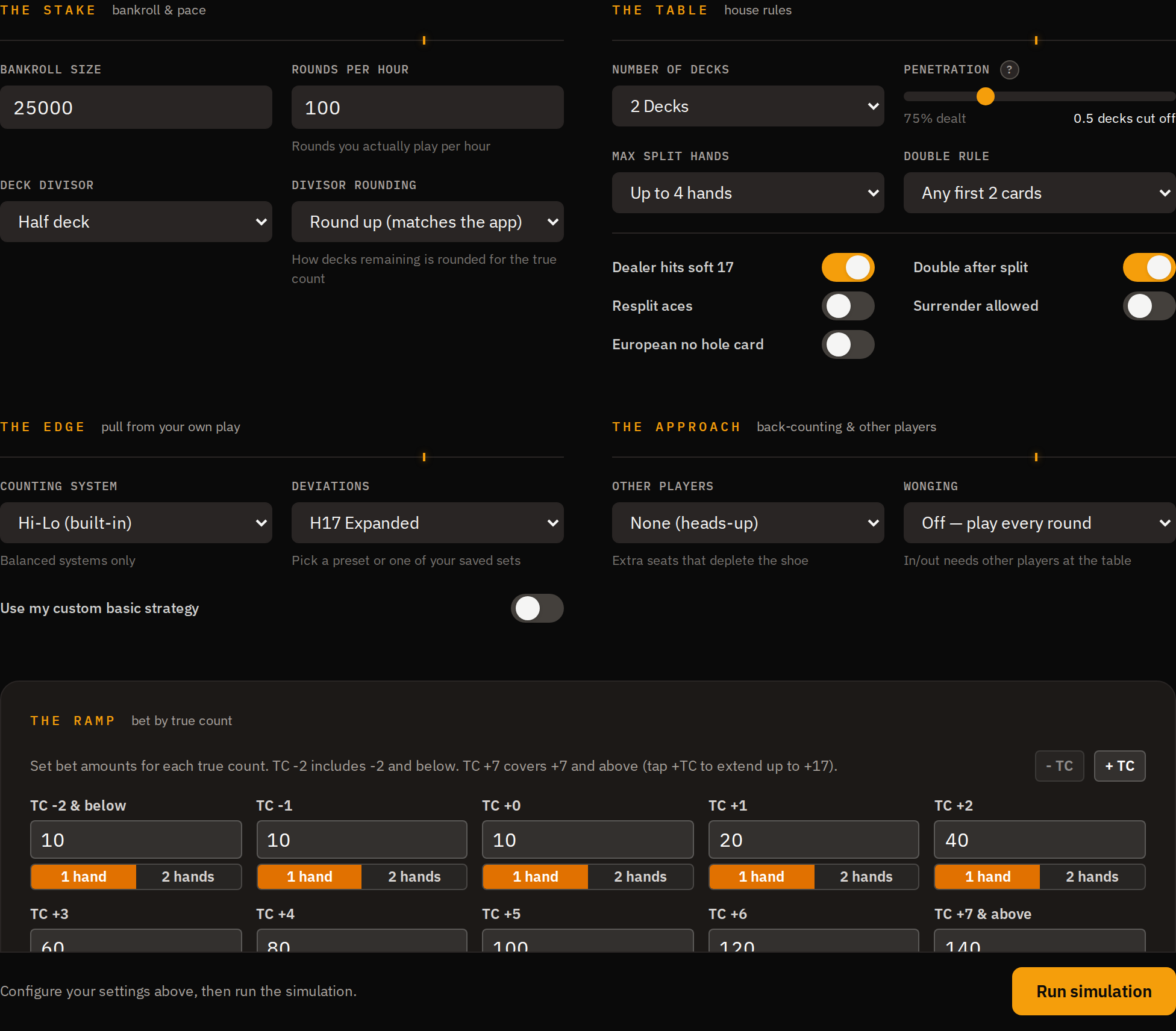
Configure the whole game.
The count
- Built-in Hi-Lo, Zen, and Hi-Opt II, or any balanced counting system you have saved (like CAC2!).
- Deck divisor for the true count: whole, half, or quarter deck.
- Choose how decks-remaining is rounded before dividing: round up to match the app, or round to nearest to match CVCX.
Strategy
- Textbook basic strategy, or play your own custom basic-strategy chart.
- Deviations off, a named H17/S17 preset set, or one of your own custom deviation sets.
- Insurance is taken on its own index, including the index from a custom deviation set.
The table
- 1, 2, 4, 6, or 8 decks, with penetration set by how many decks are dealt before the cut card.
- Dealer hits or stands on soft 17, double after split, resplit aces, and up to 2–4 split hands.
- Surrender, European no-hole-card, and a double rule of any first two cards, 9–11, or 10–11.
The bet
- A full bet ramp by true count, from −2 (and below) through +17 (and above).
- One or two hands at each true count, so multi-hand play and its correlation are modeled.
- Set your bankroll and rounds-per-hour to turn per-round results into hourly figures.
How you play it
- Play every round, or back-count: wong in and out of the same shoe, or leave for a fresh table when the count goes negative.
- Set the true count you sit out below, and the dead time it costs to find a new table.
- Seat 0–6 other players at the table to deplete the shoe the way a real game does.
What it reports
- EV per hour and per round, standard deviation per hour, risk of ruin, and hours to N0.
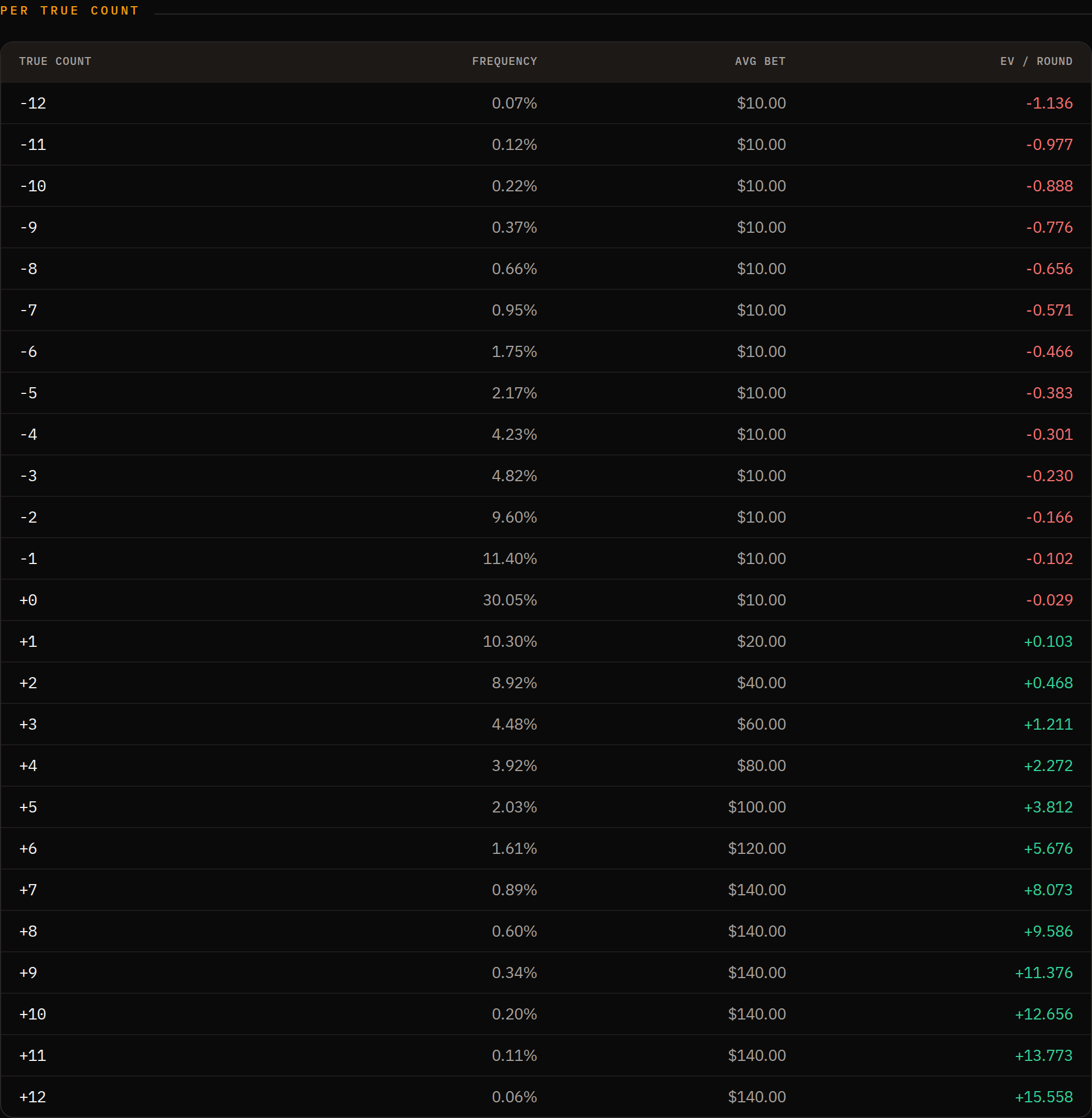
- A per-true-count breakdown: how often each count occurs, your average bet there, and its EV.
- A live progress read-out as the run converges, with the effective rounds-per-hour when wonging.
The numbers you size a bankroll on.
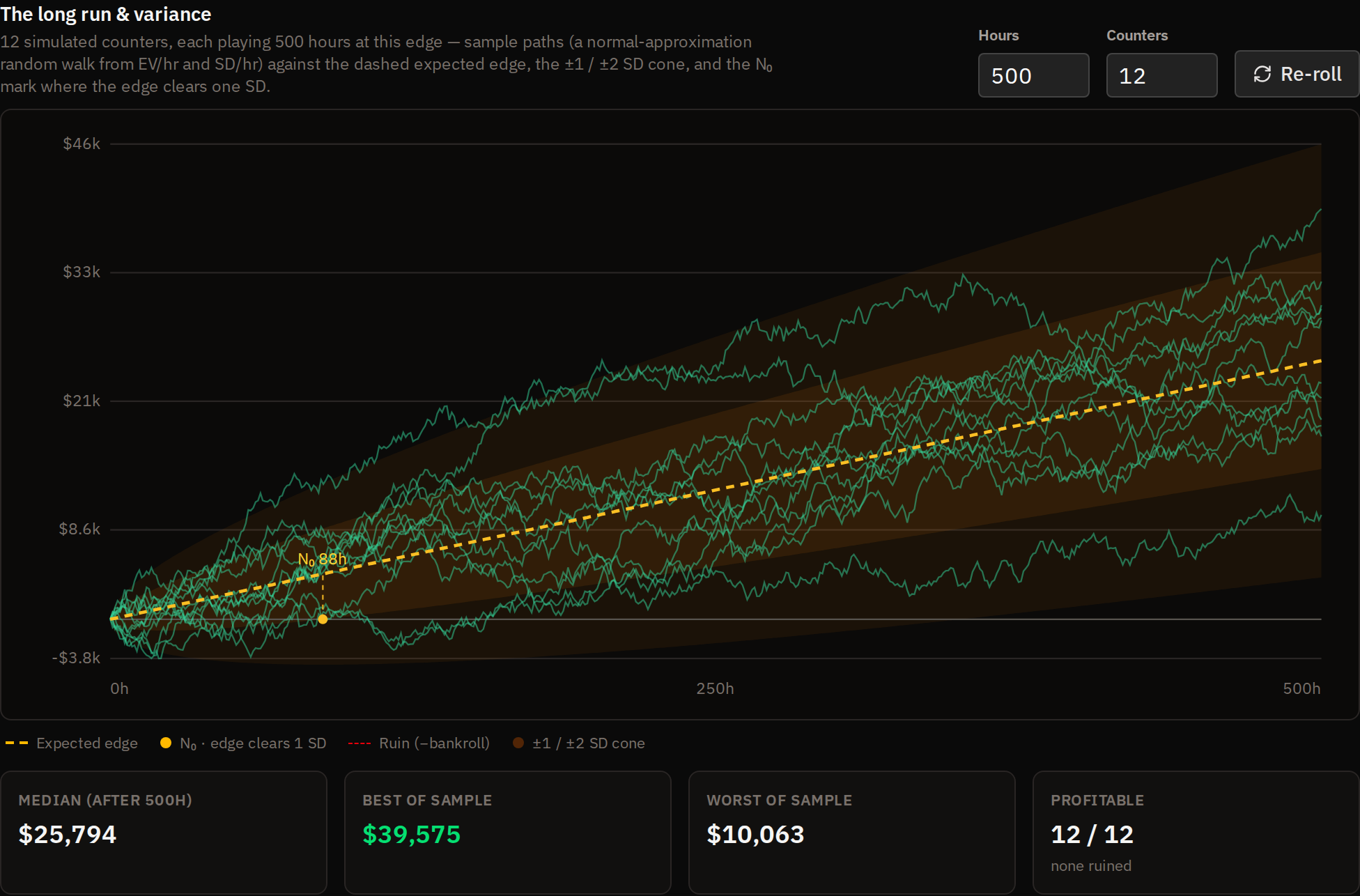
Every run reports your edge per hour and per round, standard deviation per hour, risk of ruin for your bankroll, and the hours to N0 — the point where expected profit equals one standard deviation. The result is drawn as a long-run outcome band: the expected bankroll trend, the ±1 and ±2 standard-deviation range around it, the risk-of-ruin floor, and N0 marked on the timeline.
- A shoe buy-in: the bankroll needed to absorb the drawdown of a single shoe, taken from the per-shoe drawdowns the engine measures. Other bet-spread simulators do not report it.
- A per-true-count table: how often each count comes up, your average bet there, and the EV it earns.
- Trip risk for a fixed cash-on-hand over a set number of hours — expected return, the chance of busting, the chance of ending down, and a likely ending-bankroll range.
- Sample variance trajectories so you can see what a run of hours can really look like, not just the average.
Checked against the benchmarks.
The default configuration reproduces a published double-deck Hi-Lo benchmark, and its EV/hr, SD/hr, risk of ruin, and N0 land within a fraction of established tools. The methodology and a side-by-side comparison are shown on the simulator, so you can see how it lines up before you rely on a number. You can save and name runs to compare configurations, and an identical run returns from cache instead of recomputing.
FAQ
Is this a formula or a real simulation?
How accurate is it?
What is N0?
Can I use my own counting system and deviations?
Can I model back-counting and a full table?
Does it save my runs?
Run your spread.
Set up the game you play and the way you bet it, and see the edge, the variance, and the risk before any money is on the table.